 Deltabeam
An AI lab for structural engineering
Engineer-grade AI for the built world.
We build proprietary perception models that read structural drawings at an engineer’s bar. The first product, Metareview, reviews a fabricator’s steel against the engineer’s design — live today.
Two-party reconciliation
Miss it in review, build it wrong.
Before a steel frame is fabricated, an engineer has to check the fabricator’s shop drawings against the design, member by member, across a package that can run from the hundreds of sheets into the thousands. Today that happens by hand: slow, done by the senior engineers in shortest supply, and the last line before a wrong member is cut in steel and shipped to the site.
The first product, deployed today.
Metareview checks a fabricator’s steel shop drawings against the engineer’s design and catches the discrepancies before fabrication, each one cited to the sheet and grid. It does automatically what an engineer does by hand, sheet by sheet, dragging the manual review toward zero and handing that time back to the work only an engineer can do. Where it can’t be sure, it says so and hands the page back to you.
Today it reads structural steel: shop drawings and framing plans.
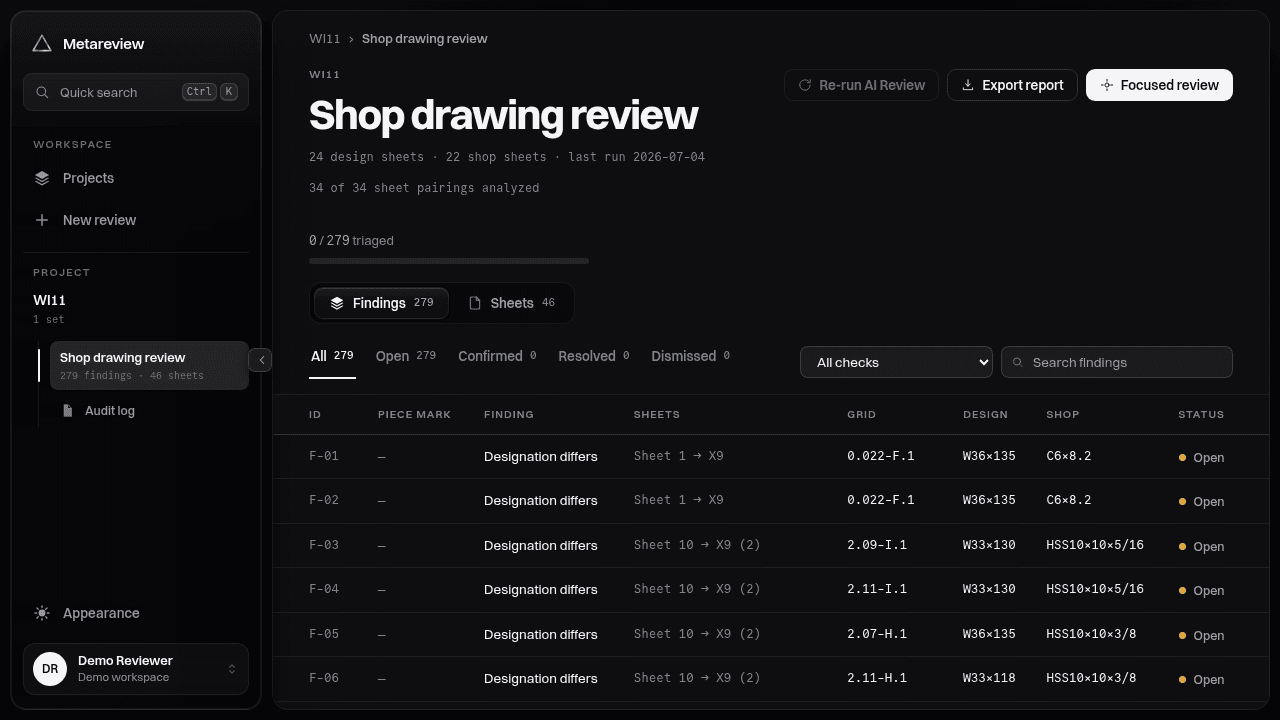
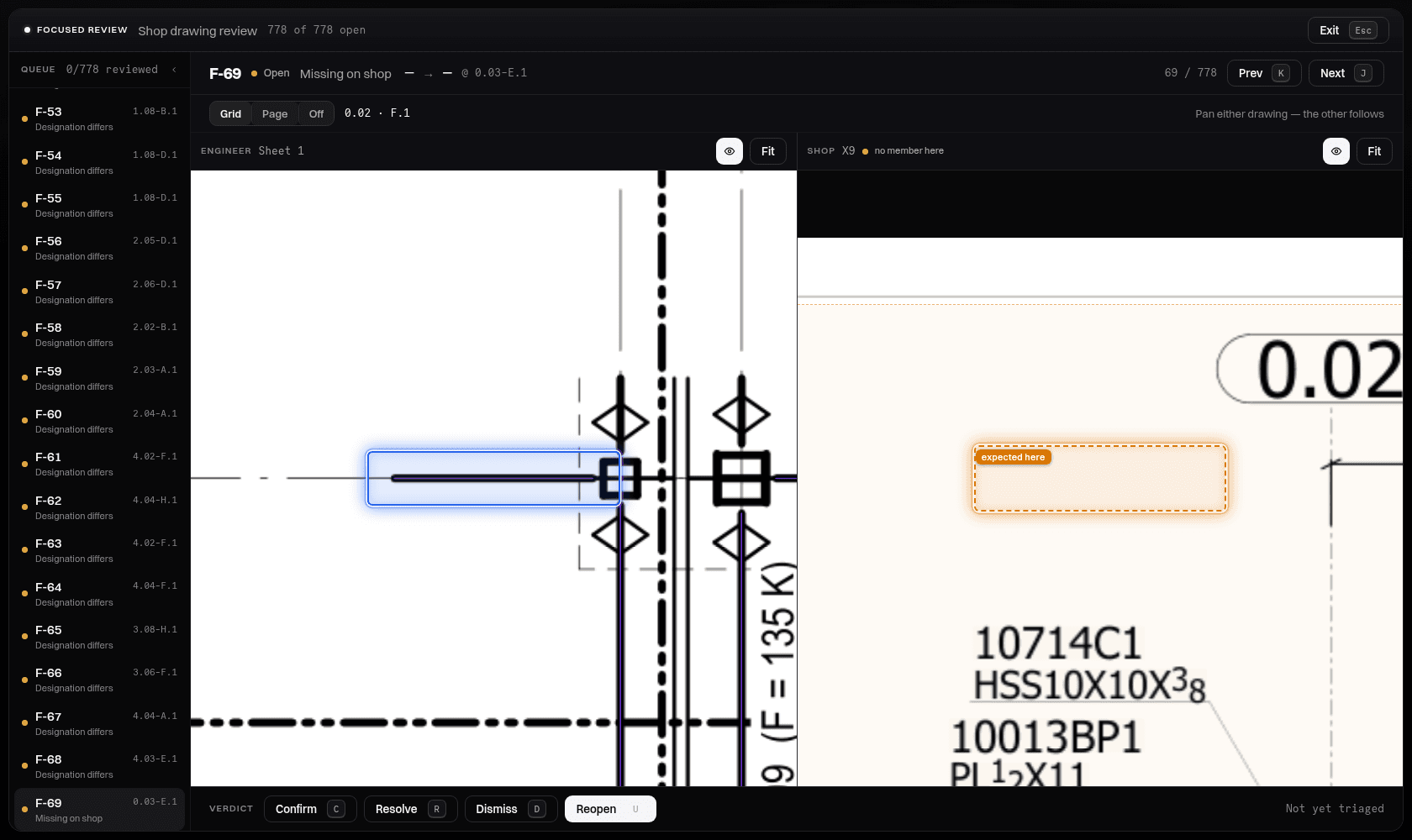
It works the whole package the way a reviewer would, then hands you the judgment instead of a wall of rows:
“Compared 9 framing pairs. 34 discrepancies for your judgment. Start with the 8 size mismatches. 6 pairings and 3 unreadable sheets need you, not me. The rest checks out.”
Every number is one click from the drawing it came from. Ask why it flagged a member and the answer is cited; tell it to reorder and the queue re-plans. It never turns a guess into a finding.
So does the AI do the review? No.
A deterministic engine finds the discrepancies; the assistant runs the workflow and routes the honest “I can’t tell” cases to you. Two records are kept and never merged: what you decided, under your name, and what the assistant did, attributed and immutable. Delete the assistant, and the letter is identical.

Reading the drawing is the first problem, not the last.
Perception is the hard part: reading a structural drawing exactly, every member and connection and dimension, at a bar a practicing engineer will stand behind. General AI can look at a drawing; it cannot read one. We built a model that can, and it is at work in Metareview today, reconciling what the fabricator detailed against what the engineer designed.
The direction from here compounds. The more work it reviews, the more it learns how each firm builds: its standards, its conventions, its corrections. That makes it the system of record for how structural work gets checked. And as it learns to read structure the way an engineer does, the same engine moves from checking the work, to reasoning about it, to designing it.
Every step gives the engineer of record more reach and moves none of the responsibility off their desk. We replace the reading, not the responsibility.
See Metareview check a real steel package.
Deployed today. We’re onboarding a small number of fabricators and engineering teams.